
Sales intelligence: what it is and how to use it
Sales intelligence explained for business leaders: what the data covers, where it comes from, how to read it, and how competitor insight completes the picture.

Sales intelligence: what it is and how to use it
A rep spends Monday researching a prospect and writes a sharp, personalized email. On Thursday the deal stalls, and the buyer says a competitor just cut its price and added a feature your team did not know about. The contact data was fine. The picture around it was missing. That gap is what sales intelligence is meant to close: it covers the buyer and account facts that tell a seller who to approach and when, and the competitor and market context that tells them what to say once they are in the room.
This guide defines sales intelligence, lists the data it uses and where that data comes from, shows how to read it (including the alternative explanations), and explains where competitor and market intelligence fits in. Rival Shark covers the competitor, industry and local market side, so the guide ends with how that side works in practice.
Key Takeaways
- Sales intelligence is the information sellers use to decide who to contact, when to reach them and what to say. It starts with accounts and buyers, and it is more useful when competitor and market context sits beside it.
- Prospect and account data is only one input. IBM’s definition also includes competitors and market conditions.
- Every signal has more than one explanation. Treat a hiring spike, a price change or a funding round as a question to check, not a conclusion.
- Data goes stale, so scoring and prioritization need regular upkeep. A first competitor report gives you a baseline, and change over time only appears once you have a second report to compare against.
- You can start today with a short written routine: pick three competitors, list the signals you will track, and review them on a fixed schedule.
Table of Contents
- What sales intelligence means
- What data sales intelligence uses and where it comes from
- How to turn the data into decisions
- Why competitor insight belongs in sales intelligence
- How to read a signal without overreading it
- What the tools cover and where they differ
- How Rival Shark covers the competitor and market side
- A one-week routine you can start without new software
- FAQ
- Sources
What sales intelligence means
Sales intelligence is the collection of data and insights that sellers use to make informed decisions across the sales process, including understanding prospects and customers, as Salesforce describes it. IBM’s definition is wider: the systematic collection of information about prospects, customers, competitors and market conditions, used to improve sales performance and decision-making.
The two definitions point to the same practical split:
- Account and buyer intelligence answers who to contact and when. Examples: company size, the right contact, a recent funding round.
- Competitor and market intelligence answers what to say and where to compete. Examples: a rival’s pricing change, new positioning, shifts in demand.
A sales team that uses only the first kind reaches the right people with a message that may not fit the market they are standing in. A team that uses only the second understands the landscape but lacks a target list. Most small teams need both, and they rarely need both at the same depth.
Sales intelligence, sales insight and market intelligence
The terms overlap, so here is a working vocabulary:
- Sales intelligence is the raw material: data and signals about accounts, buyers, competitors and conditions.
- Sales insight is the conclusion drawn from it, for example “mid-size clinics in our region are asking about integrations more than price.” IBM separates the two: sales intelligence gathers data, while sales analytics turns it into insight that improves the sales process.
- Market intelligence looks at the whole market: industry trends, competitor movements and demand. It informs strategy more than any single deal. Simple AI Engineering’s go-to-market piece draws a similar line between prospect-level and market-level work.
The distinction matters because the two kinds of intelligence answer different questions on different time scales. A rep needs the first before Tuesday’s call. A founder needs the second before deciding where to spend the next quarter.
What data sales intelligence uses and where it comes from
Salesforce lists several kinds of data:
| Data type | What it tells you | Example |
|---|---|---|
| Firmographic | What kind of company it is | Industry, size, locations, revenue, growth stage |
| Contact | Who to talk to | Role, email, phone |
| Technographic | What technology the account uses | The software a prospect already runs |
| Sales-event trigger | Why now might be the right time | A leadership change, an expansion, a funding round |
| Deal | How comparable sales went | Past won and lost opportunities |
IBM adds historical sales data and intent signals, meaning behavior that suggests a buyer is researching a purchase.
The same Salesforce page names the usual sources: conversations with prospects, company websites and announcements, social media, industry resources, public records, and your own CRM (customer relationship management system), billing, product-usage and customer-feedback records.
Two points follow for a small team. First, your own records are the cheapest and most relevant source, because they describe buyers who already talked to you. Second, public sources only show what companies choose to publish or what regulators require. Any tool, including Rival Shark, works from information like that, and none of it gives access to a competitor’s confidential material.
How to turn the data into decisions
Collecting data is the easy part. Salesforce’s guidance is to gather company-level and person-level information, centralize it in the CRM, sync relevant email, calendar and call information, and connect the findings to what the prospect needs. A workable routine for a small team looks like this:
- Define the decision first. “Which accounts should we call this week?” and “Should we change our pitch against Competitor A?” need different data. Write the decision down before collecting anything.
- Pick a short signal list. Five or six signals you actually review beat thirty you ignore.
- Record the source and date. A figure with no date cannot be judged later.
- Write the interpretation separately from the fact. “Competitor B posted four sales roles” is a fact. “Competitor B is expanding its sales team” is an interpretation.
- Attach an action and an owner. A finding that nobody owns never reaches a conversation with a buyer.
- Review on a schedule. Weekly for a sales team, monthly or quarterly for strategy.
Prospecting and prioritization
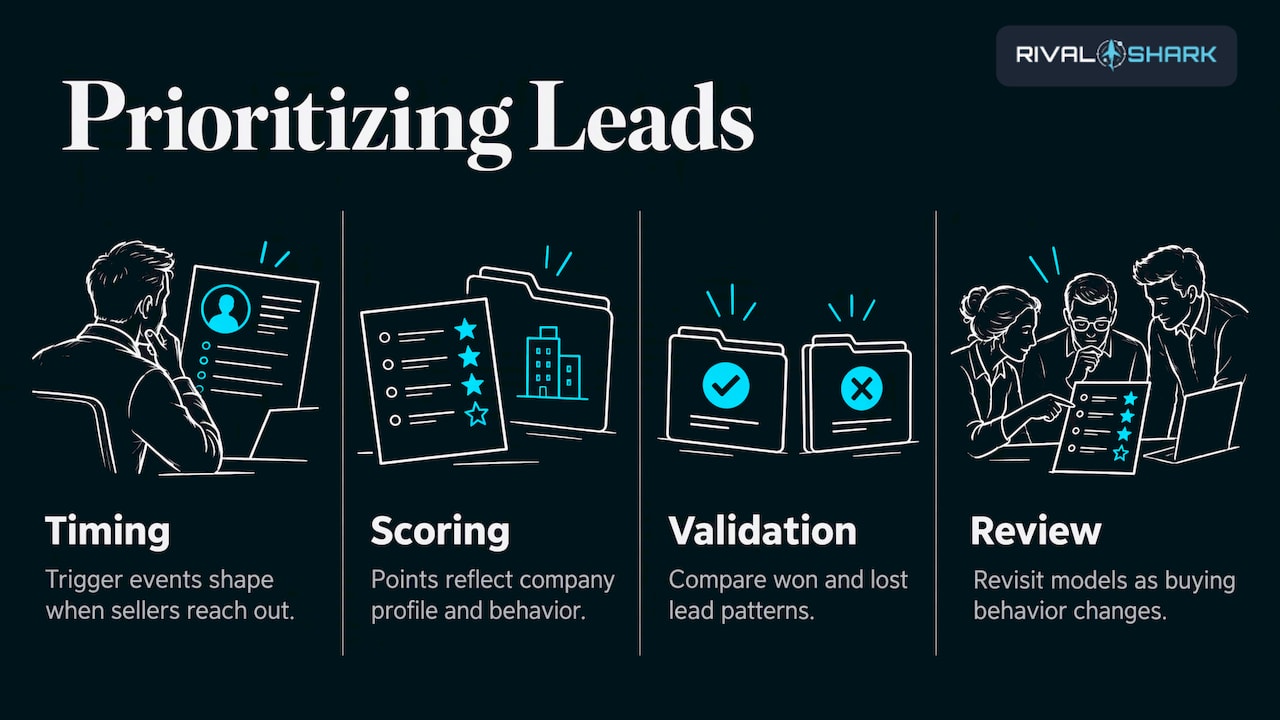
Intelligence helps sellers prioritize leads and personalize outreach by using what they know about a prospect’s company to prepare a relevant conversation. Timing matters as much as targeting. A playbook on signal-based outbound strategy shows how trigger events and prospect activity can shape when and how a seller reaches out.
Lead scoring is the usual way to formalize prioritization. A score assigns points to attributes such as company profile and behavior. Salesforce’s lead-scoring guide notes that scoring depends on good-quality, current CRM data and recommends learning conversion patterns from both won and lost leads. That last point is easy to skip. A model trained only on wins cannot tell you which signals separate a win from a near miss. Buying behavior also changes, so the model needs periodic review. Material on keeping lead-scoring models current covers how signals and validation fit together.
Why competitor insight belongs in sales intelligence
IBM notes that competitor intelligence can show competitor activities, pricing, market positioning and customer perception, and that teams can use that picture to find ways to differentiate their offerings. For a seller, that has four concrete uses:
- Objection handling. If buyers keep bringing up a rival’s new bundle, the team needs an answer before the next call, not after the next loss.
- Positioning. Messaging that ignores how competitors describe themselves ends up sounding the same as theirs.
- Pricing conversations. Knowing where your price sits against the alternatives, with sources, keeps a discount from becoming a guess.
- Where to compete. Some segments or locations are crowded, others are not. That is a market question, and it shapes which accounts deserve effort.
This is what people mean by competitive sales enablement: giving sellers the competitor and market material they need to run a sales conversation, such as battle cards (one-page summaries of how to position against a specific rival) and findings from deals you won and lost. It is a practice, not a product category, and the quality of the inputs sets the quality of the output.
A hypothetical example
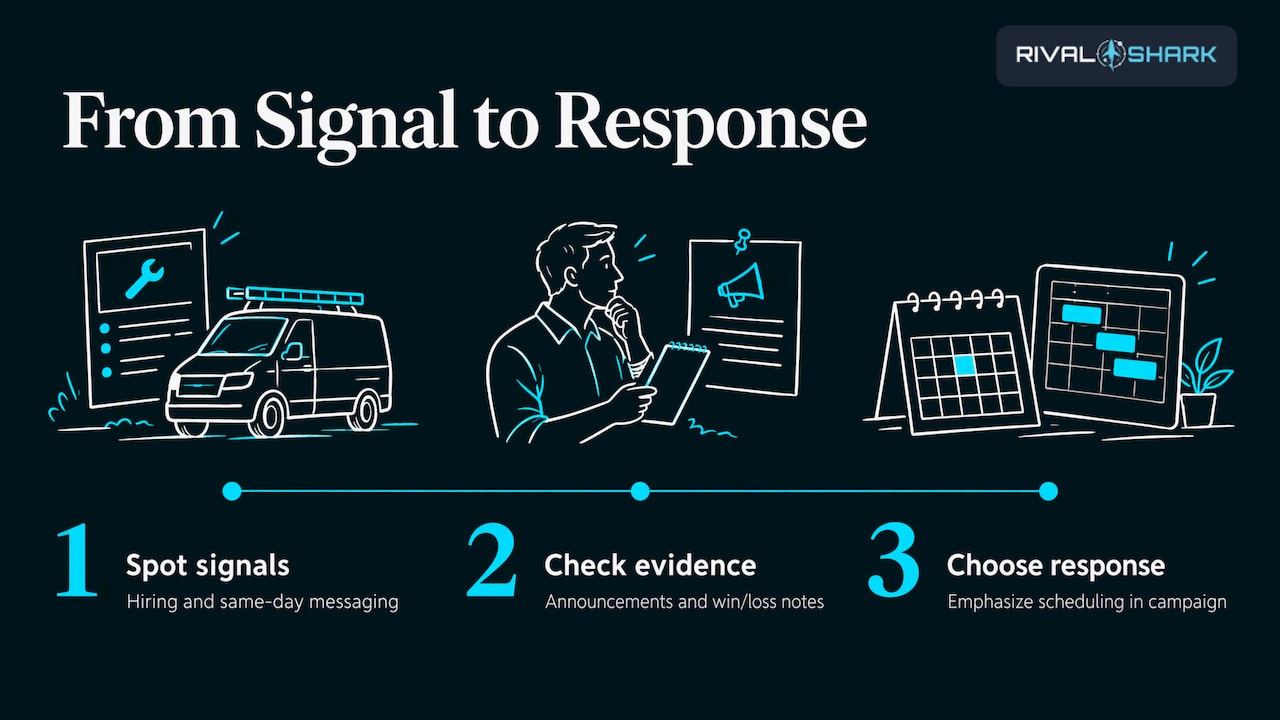
This example is illustrative, not a customer story. A regional HVAC company with three locations tracks two competitors. Over two months it sees that one competitor has posted several technician job openings in a neighboring county and changed its website messaging to emphasize same-day service.
There are at least three explanations: the competitor is expanding into the county, it is replacing staff who left, or it is repositioning to win on speed in its existing territory. Each calls for a different response. The owner does not act on the first guess. They check whether the competitor has announced a new location, look at their own win and loss notes for mentions of response time, and decide whether to emphasize their own scheduling in the next campaign. The signal started the question, and a second source resolved it.
How to read a signal without overreading it
The common failure in intelligence work is treating a signal as proof. Use these checks:
- Look for a second source. A job posting plus a press release is stronger than either alone.
- List the alternative explanations. Write at least two before choosing one.
- Check the date. Old pages and stale records can describe a situation that has already changed.
- Separate fact, interpretation and recommendation. Keep them in different lines so a reader can disagree with one without discarding the others.
- Match the size of the response to the strength of the evidence. A single signal may justify a conversation, not a pricing overhaul.
- Do not infer intent. Public information shows what a competitor did. It does not show why, and it does not show what they plan next.
Salesforce also advises that sellers balance how much research they do, and that any software holding this information should keep it private. Both apply to small teams: set a time limit for research per account, and check where your tools store and use the data you enter.
What the tools cover and where they differ
Different tools serve different parts of the job:
| Need | What serves it | What to expect |
|---|---|---|
| Contact and account lists for prospecting | Contact databases and CRM-connected enrichment tools | Strong at who to call, narrower on competitor and market context |
| Tracking a named rival’s sales and messaging in depth | Dedicated competitive intelligence platforms, many aimed at larger revenue teams | Deep on the competitors you configure, usually with more setup |
| Competitor, industry and local market reports with next steps | Rival Shark | Structured reports that cover competitors and markets and end with recommended actions |
| One-off questions | A general AI assistant | Flexible, but you supply the context and check the sourcing |
Specialist tools have real strengths, and an analyst team will go deeper on a single account than any self-serve product. The question is what your team needs to decide this quarter. If the gap is competitor and market context, Rival Shark compares itself with manual research and with general AI assistants on its own pages.
How Rival Shark covers the competitor and market side
Rival Shark is an AI-powered platform for competitor, industry and local market intelligence. You describe your business and objective, and it produces structured reports in minutes instead of days. The reports include sourced figures and an urgency rating for each recommended action, and they end with clear next steps. They cover competitor pricing, positioning, product launches, hiring patterns and sentiment, along with demand shifts and industry trends. Features include sales battle cards, win/loss intelligence, expansion signals, share of voice metrics and local market scoring. It helps leaders make informed choices. The decision stays with them, and nothing is executed automatically.
The product is self-serve, and Rival Shark says it does not train on, share or sell customer data. A first report gives you a baseline. To see change over time you need a second report to compare it with.
Who gets what:
- Sales leaders get competitor intelligence and battle cards for live deals.
- Marketing leaders get positioning and share of voice metrics.
- Product and strategy leaders get market and competitive intelligence for planning.
- Local and multi-location operators get local market intelligence, including market scoring.
Plans and current terms are on the Rival Shark pricing page.

If you want to see what a report looks like before choosing a plan, the free industry snapshot is the place to start.
A one-week routine you can start without new software
Whatever tools you use, this routine builds the habit:
- Day 1: Choose three competitors and one decision you need to make this quarter, such as whether to change your pitch or enter a new location.
- Day 2: List six signals: pricing page changes, new product announcements, job postings, customer reviews, messaging changes and new locations or markets.
- Day 3: Record the current state of each signal for each competitor, with the source and date. This is your baseline.
- Day 4: Pull your own CRM notes on the last ten won and ten lost deals. Note which competitors came up and why you won or lost.
- Day 5: Write one page: three facts, two interpretations with alternatives, one recommended action with an owner.
- Next review: Repeat the signal check at your chosen interval and compare it with the baseline. Differences are the findings.
For wider market questions, Rival Shark’s B2B market research guide walks through methods and what to decide with the results, and the market intelligence blog collects related articles.
FAQ
Is sales intelligence the same as competitive intelligence?
No, but they overlap. Sales intelligence is the broader term for information that helps sellers act, and IBM’s definition includes competitors and market conditions alongside prospects and customers. Competitive intelligence is the part focused on rivals and the market around them.
What does sales intelligence data include?
It typically includes firmographic, contact, technographic, event-trigger and deal data, as Salesforce lists. It can also include intent signals and historical sales data. Competitor pricing, positioning and market data extend that picture.
How often should we review competitor signals?
Match the review to the decision. Sales teams in active deals often check weekly, while strategy questions suit a monthly or quarterly review. Whatever you pick, compare each review with a dated baseline so you can see what changed.
Does a small business need sales intelligence?
Yes, in proportion to its decisions. A founder choosing a price or a location needs the same kind of evidence as a larger team, only less of it. Start with a short list of competitors and signals, and expand when you find the questions you cannot answer.
Sources
- What is Sales Intelligence? | Salesforce
- What Is Lead Scoring? | Salesforce
- What is Sales Intelligence? | IBM
- Signal-Based Outbound Strategy: A Playbook for B2B SaaS | Kynzo
- AI Go-to-Market: How to Sell an AI Product in 2026 | Simple AI Engineering
- Churn Risk From Conversations: Signals, Models, Validation | LEXIC.AI
See your market's saturation score
Run a local market report in minutes. Card required, 7-day free trial, no charge until it ends.
Keep reading